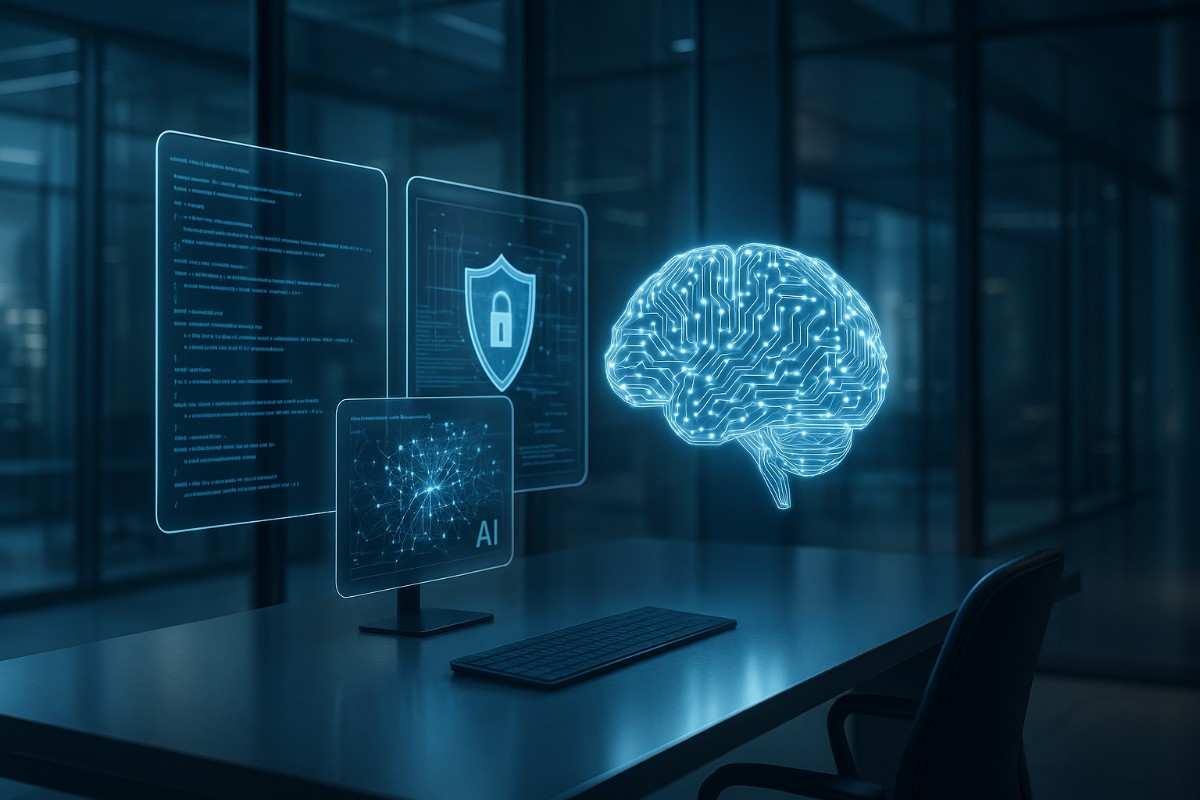
Artificial Intelligence has rapidly shifted from being a futuristic concept to a transformative force reshaping every industry. Among its most impactful advancements are Generative AI, AI-driven cybersecurity, and the growing trend toward smaller, more efficient language models. Together, these innovations are redefining how businesses operate, how digital systems stay secure, and how users interact with intelligent technology.
🌟 Generative AI: Creativity Meets Computation
Generative AI refers to models capable of creating new and original content—whether text, images, audio, video, code, or even synthetic data. Tools like ChatGPT, Claude, Gemini, and Midjourney have showcased how AI can act as a creative assistant, thought partner, educator, and productivity enhancer.
Where Generative AI is Making an Impact
- Content creation: blog posts, articles, marketing copy, video scripts
- Design & media: digital artwork, product prototypes, film pre-visualization
- Software development: code generation, debugging, documentation
- Healthcare: drug discovery, medical imaging enhancement
- Education & training: personalized learning, simulation-based learning
The power of generative AI lies in its ability to understand patterns in vast data and produce human-like results. However, this same capability also introduces new risks—especially in the cybersecurity landscape.
🛡 AI in Cybersecurity: A Double-Edged Sword
Cybersecurity threats grow more sophisticated every year, and traditional detection methods struggle to keep pace. AI is stepping in as a critical defense tool capable of analyzing anomalies, detecting malicious behavior, and automating incident response in real time.
How AI Strengthens Cybersecurity
- Threat Detection: Identifies suspicious patterns faster than manual monitoring
- Phishing & Spam Detection: Recognizes language and structure of attacks
- Fraud Prevention: Protects banking, e-commerce, and identity verification
- Autonomous Security Systems: Automated remediation without human delays
- Security Analytics: Predictive behavioral analysis to stop zero-day threats
However, cybercriminals are also exploiting AI. Generative AI can be used to create realistic phishing emails, deepfake identities, and automated malware. This has sparked the need for AI-powered defense vs. AI-powered attacks, escalating cybersecurity to an AI-driven battlefield.
⚙️ The Rise of Smaller Language Models (SLMs)
While large-scale models with hundreds of billions of parameters have dominated headlines, a new trend is emerging: Smaller Language Models. These models aim to deliver high-quality performance at significantly lower computational cost.
Examples include: Phi-3, LLaMA 3, Gemma, Mistral, Qwen, TinyLLaMA, and many on-device AI models
Why Smaller Models Matter
| Benefit | Description |
|---|---|
| Lower cost & energy use | Reduced training & inference resources |
| On-device performance | Works offline on laptops, phones, edge devices |
| Faster responses | Reduced latency for real-time applications |
| Data privacy | Processing locally instead of cloud |
| Custom fine-tuning | More practical for specialized enterprise tasks |
Companies increasingly prefer task-specific AI over massive general-purpose AI models. This shift democratizes AI—making it accessible to startups, universities, and developing regions.
🔮 The Future of AI: Convergence of Intelligence & Efficiency
The next era of AI will focus on:
- Hybrid AI systems combining large and small models for efficiency
- AI-augmented cybersecurity ecosystems
- Personalized AI agents embedded into devices and workflows
- Ethical and responsible AI governance
- Synthetic data improving model safety and accuracy
AI will become more personal, private, and powerful—not by being bigger, but by being smarter.